
ISO 9001:2015 Quality Management System (QMS)
ISO 9001 Certification serves as the global benchmark for Quality Management Systems (QMS), enabling organizations to establish structured operational processes, enhance customer satisfaction, and drive continuous improvement. By implementing these international standards, businesses demonstrate their commitment to operational clarity, risk mitigation, and consistent quality delivery across all market sectors.
Achieving this credential validates that an entity maintains structured oversight over its processes, supplier relationships, risk-based decision frameworks, and performance evaluations. Organizations holding an accredited ISO 9001 Certification unlock strategic business advantages, including enhanced market access, higher tender success rates, streamlined operational workflows, and reduced compliance overheads.
- Core Purpose: Establishing standardized process controls, continuous improvement cycles (PDCA), and risk-based management strategies.
- Primary Scope: Applicable to all operational scales across manufacturing, construction, healthcare, power generation, engineering, and service domains.
- Assessment Framework: Involves two main operational stages stage 1 documentation review and stage 2 comprehensive site implementation evaluation.
- Verification Authority: Delivered by independent, accredited certification bodies ensuring impartial, expert compliance checks.
- Long-term Validity: Structured on a 3-year certification cycle supported by annual surveillance evaluations.
What Is ISO 9001 Certification and Why Is It Essential for Modern Organizations?
ISO 9001 Certification is an internationally recognized standard designed to regulate and evaluate an organization’s Quality Management System (QMS). At its core, the standard provides a methodical framework for managing business operations, minimizing risks, establishing predictable execution practices, and systematically meeting regulatory and customer expectations.
Organizations across all vertical sectors adopt ISO 9001 Certification to modernize their internal structures. Without standardized quality metrics, operations often experience fragmented workflows, inconsistent service delivery, elevated defect ratios, and regulatory compliance gaps. Attaining ISO 9001 Certification resolves these hurdles by embedding quality governance into daily leadership actions, operational planning, resource distribution, and performance tracking.
Furthermore, certified entities gain immediate commercial leverage. Modern supply chains, governmental authorities, and multinational partners strictly mandate ISO 9001 Certification as a prerequisite for contract bidding and vendor onboarding. It establishes a universal language of quality and accountability, transforming reactive operational practices into proactive, performance-driven business outcomes.
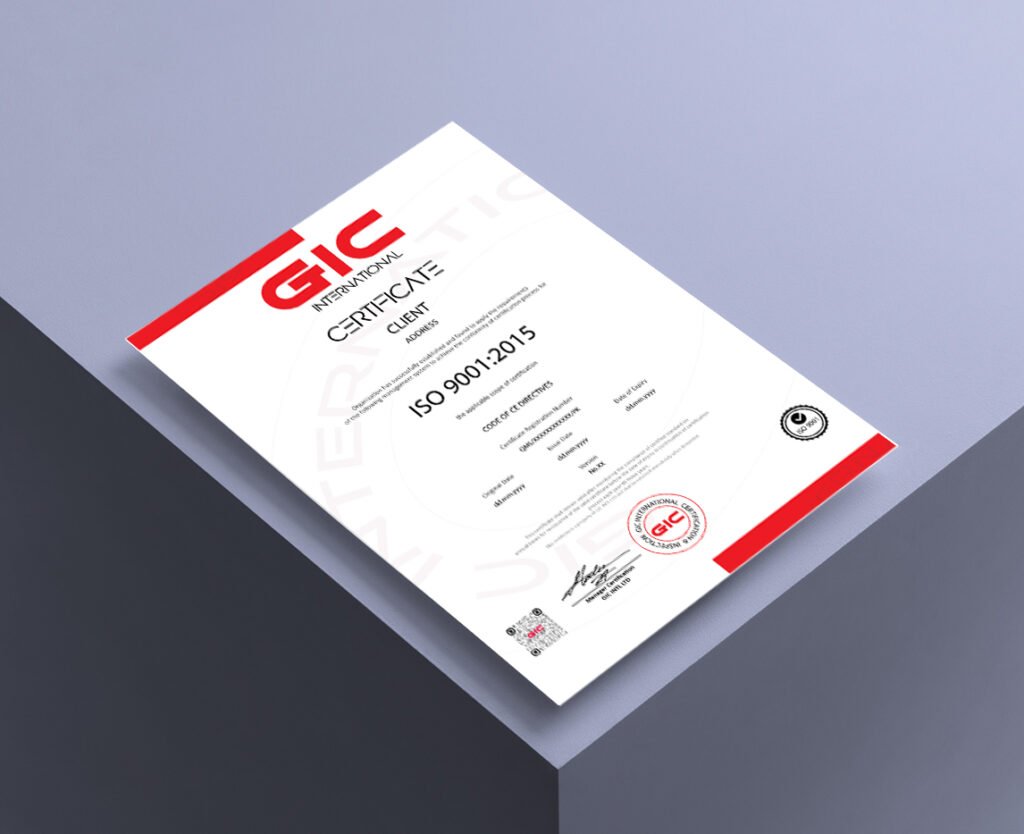
How Does GIC International Certifications Fast-Track the Assessment Process?
Navigating the route to international standard compliance requires a certification body capable of combining rigorous assessment criteria with efficient verification workflows. GIC International Certifications delivers direct, streamlined certification services designed to fast-track evaluation steps without sacrificing compliance integrity or accreditation standards.
Through structured audit frameworks and optimized verification schedules, GIC International Certifications simplifies the assessment journey for complex organizations. The organization focuses strictly on independent evaluation, gap identification, and process validation, ensuring that clients experience an efficient, professional, and friction-free path to compliance.
| Certification Stage | Service Actions Provided by GIC International Certifications | Operational Impact for the Organization |
| Application & Scope Mapping | Defining project parameters, organizational boundaries, and applicable regulatory scope. | Rapid project kickoff with zero ambiguity regarding compliance boundaries. |
| Stage 1 Audit (Document Review) | Thorough review of QMS policies, process maps, readiness metrics, and standard clauses. | Timely identification of system gaps prior to physical operational assessments. |
| Stage 2 Audit (Site Verification) | On-site or remote operational evaluation of process execution, interviews, and evidence. | Full verification of practical QMS execution across all core operations. |
| Certification Decision | Independent review of audit findings by senior lead auditor panels. | Speedy issuance of globally valid ISO 9001 Certification certificates. |
| Surveillance & Continuity | Structured annual review cycles to maintain ongoing QMS compliance. | Continuous, long-term operational alignment and international validity. |
By relying on expert lead auditors, GIC International Certifications maintains a track record of 100% successful verification results for fully prepared client systems across every commercial sector.
What Are the Tentative Timelines and Economical Investment Plans?
Achieving an accredited ISO 9001 Certification must be both accessible and cost-effective. GIC International Certifications provides economical pricing structures positioned below prevailing market trends to ensure high return on investment for small, medium, and large enterprises.
These estimates represent tentative costs and duration ranges for planning purposes; exact figures depend on organizational scale, employee headcount, site complexity, and operational risk factors.
| Organization Scale | Targeted Project Scope | Tentative Timeline | Market Average Investment | GIC International Economical Rate |
| Micro Business (1 to 15 Employees) | Single operational site with standard processes | 1 to 2 Weeks | PKR 120,000 – PKR 180,000 | PKR 75,000 – PKR 95,000 |
| Small to Medium Entity (16 to 75 Employees) | Multi-departmental workflows or dual-site facilities | 2 to 4 Weeks | PKR 250,000 – PKR 350,000 | PKR 140,000 – PKR 190,000 |
| Large Enterprise (76 to 250 Employees) | Complex operational lines with technical processes | 4 to 6 Weeks | PKR 450,000 – PKR 650,000 | PKR 260,000 – PKR 340,000 |
| Multinational / Industrial Scale (250+ Employees) | Multi-site manufacturing or heavy industrial operations | 6 to 8 Weeks | PKR 750,000 – PKR 1,200,000+ | PKR 450,000 – PKR 620,000 |
Which Key Specialized Sectors Benefit from Accredited Lead Auditor Expertise?
Industrial operations require specialized sector knowledge during assessment to ensure that complex workflows, regulatory norms, and technical requirements are thoroughly understood. GIC International Certifications deploys professional, accredited lead auditors who possess deep domain expertise across specialized sectors:
- Construction Industry: Audit protocols focus on project management practices, site safety quality integrations, subcontractor evaluations, material traceability, and structural compliance standards.
- Pharmaceuticals Domain: Lead auditors bring specialized knowledge of Good Manufacturing Practices (GMP), cleanroom maintenance protocols, batch testing validation, data integrity, and strict cross-contamination controls.
- Shipping Lines and Logistics: Auditing focuses on fleet operational management, international supply chain traceability, container security controls, cargo handling procedures, and maritime safety integrations.
- Power Generation Facilities: Certification checks focus on asset maintenance management, emergency response protocols, energy distribution reliability, operational risk assessments, and environmental safety standards.
- Hospitals and Healthcare Services: Assessments cover clinical management processes, patient safety protocols, medical record privacy, hygiene standards, equipment calibration, and emergency service readiness.
- Engineering and Infrastructure Projects: Expert audits evaluate design controls, structural verification tests, engineering documentation precision, fabrication protocols, and large-scale quality assurance frameworks.
By matching accredited lead auditors to specific project scopes, GIC International Certifications provides precise evaluations that enhance operational efficiency while assuring 100% successful results for compliant systems.
FAQ’s
How long does an ISO 9001 Certification remain valid?
An ISO 9001 Certification is valid for three years from the date of issuance. To maintain valid status, certified organizations must successfully complete annual surveillance audits during years one and two, followed by a formal recertification audit in year three.
Can ISO 9001 Certification be integrated with other ISO standards?
Yes. ISO 9001 shares a common High-Level Structure (Annex SL) with standards like ISO 14001 (Environmental Management) and ISO 45001 (Occupational Health & Safety). This shared framework allows organizations to implement a unified Integrated Management System (IMS), reducing administrative overlap and streamlining combined certification audits.
How does GIC International Certifications maintain cost-effective pricing?
GIC International Certifications optimizes its audit schedules and minimizes unnecessary administrative overhead, allowing the organization to offer direct assessment services at rates significantly more economical than prevailing market trends.
What happens if non-conformities are identified during the audit?
If the Stage 2 assessment reveals non-conformities, the client organization receives a detailed findings report. Once the organization implements the necessary corrective actions and submits objective evidence, GIC International Certifications verifies the resolutions to finalize certification approval.