

ISO 14001 Environmental Management System (EMS)
ISO 14001 Certification stands as the global standard for establishing, implementing, and maintaining an Environmental Management System (EMS). It equips businesses with a structured operational framework to minimize ecological footprints, lower waste output, optimize resource utilization, and satisfy stringent legal compliance demands. Rather than dictating fixed performance targets, the standard outlines adaptable protocols that align an organization’s commercial goals with long-term environmental responsibility.
Organizations seeking ISO 14001 Certification gain a competitive advantage by proving their commitment to sustainable practices to international clients, regulatory bodies, and investors. By integrating the Plan-Do-Check-Act (PDCA) model, businesses systematically manage environmental risks, prevent costly regulatory fines, and generate long-term cost savings through improved operational efficiencies.
- Core Purpose: Establishing an internationally recognized Environmental Management System (EMS) to drive sustainability.
- Primary standard: ISO 14001:2015 / ISO 14001:2026 framework.
- Key Benefits: Regulatory compliance, reduced carbon footprint, resource efficiency, cost reduction, and enhanced brand equity.
- Target Sectors: Construction, Pharmaceuticals, Shipping Lines, Power Generation, Hospitals, Engineering, and Manufacturing.
- Direct Solution: Direct assessment and certification services through GIC International Certifications.
What Is ISO 14001 Certification and Why Is It Essential for Modern Organizations?
ISO 14001 Certification validates that an entity operates an accredited Environmental Management System aligned with international benchmarks. In an global market focused on Environmental, Social, and Governance (ESG) standards, relying on informal sustainability policies leaves companies vulnerable to regulatory penalties and lost market opportunities.
The certification process requires companies to rigorously identify every environmental aspect of their operation. This includes monitoring air emissions, wastewater discharge, hazardous material handling, energy consumption, and solid waste disposal. Adopting ISO 14001 Certification shifts an organization’s stance from reactive problem-solving to proactive risk management, embedding environmental governance directly into daily operations and overall corporate strategy.
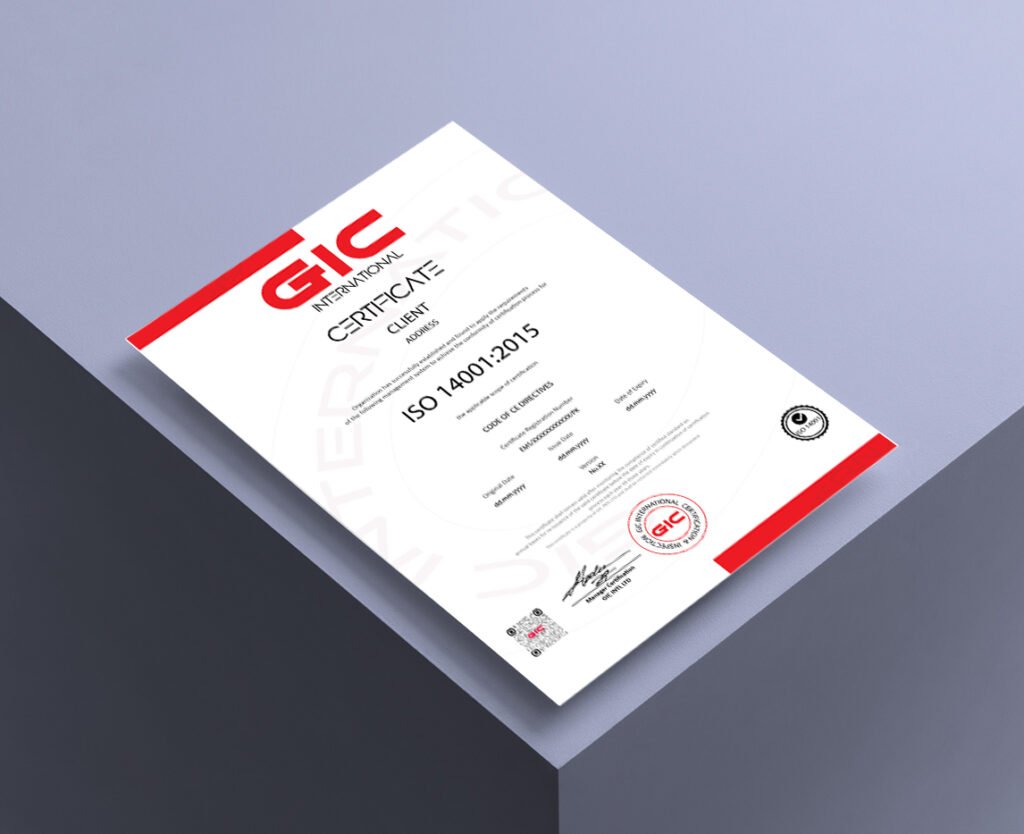
How Does GIC International Certifications Expedite the Certification Journey?
GIC International Certifications simplifies the assessment process by offering streamlined, professional certification services. By focusing strictly on clear evaluation, transparent audit execution, and eliminating unnecessary administrative friction, GIC International Certifications provides the fastest and easiest pathway to compliance.
To help organizations maintain momentum, GIC International Certifications structures its certification services through a clear, straightforward process designed to prevent project delays:
| Service Stage | Effort Implemented by GIC International Certifications | Operational Goal | Sector Success Rate |
| Stage 1: Documentation Audit | Comprehensive review of EMS scope, policy documents, and readiness indicators. | Identify structural gaps prior to full on-site evaluation. | 100% Success across all sectors |
| Stage 2: On-Site Assessment | Dynamic evaluation of operational processes, environmental aspect controls, and legal adherence. | Verify real-world compliance and operational integration. | 100% Success across all sectors |
| Certification Decision | Rapid review of audit reports by senior accredited technical panels. | Deliver formal ISO 14001 Certification without unnecessary delay. | 100% Success across all sectors |
| Surveillance Audits | Annual periodic evaluations to maintain long-term compliance and support continuous improvement. | Ensure ongoing system validity and continuous standard compliance. | 100% Success across all sectors |
What Are the Estimated Timelines and Costs for ISO 14001 Certification?
The duration and cost of an ISO 14001 assessment depend on company size, operational complexity, and total workforce scale. Below is an economical pricing framework provided by GIC International Certifications, offering cost-effective rates relative to general market trends.
Note: The values listed below are tentative estimates for budgeting purposes and do not represent final binding quotes.
| Organization Scale | Employee Count | Estimated Assessment Timeline | Tentative Cost (PKR) |
| Small-Scale Enterprise | 1 to 25 employees | 1 – 2 Weeks | PKR 150,000 – PKR 250,000 |
| Medium-Scale Enterprise | 26 to 100 employees | 2 – 4 Weeks | PKR 260,000 – PKR 450,000 |
| Large Industrial Enterprise | 101 to 500 employees | 4 – 6 Weeks | PKR 460,000 – PKR 750,000 |
| Multi-Site Corporate Division | 500+ employees | 6 – 8 Weeks | PKR 760,000 – PKR 1,200,000+ |
Why Is GIC International Certifications the Preferred Partner Across Specialized Industries?
High-risk and technical industrial environments demand auditors who understand specific operational mechanics, legal exposure, and sector-specific environmental risks. GIC International Certifications deploys teams led by highly trained Lead Auditors and professional accredited evaluators who bring deep domain experience to every project.
GIC International Certifications provides specialized audit expertise across critical technical industries:
- Construction: Expertise in evaluating site run-off controls, heavy machinery emission levels, urban noise mitigation, demolition waste diversion, and structural environmental impact assessments.
- Pharmaceuticals: Focused assessment of chemical effluent treatment, bio-hazard containment, cleanroom energy balance, sterile packaging waste, and strict regulatory compliance controls.
- Shipping Lines: In-depth technical verification of marine pollution prevention (MARPOL), ballast water management practices, vessel fuel efficiency strategies, and port environmental safety protocols.
- Power Generation: Assessment of thermal emissions, stack monitoring systems, turbine cooling water discharge, fuel storage safety, and renewable grid transition frameworks.
- Hospitals: Specialized audits covering clinical waste handling, hazardous pharmaceutical disposal, radiological safety, energy-intensive HVAC optimization, and infection control waste streams.
- Engineering & Heavy Manufacturing: Tailored evaluation of metal finishing run-off, raw material usage efficiency, scrap recycling loops, shop-floor safety-environmental alignment, and factory footprint reductions.
By pairing sector-specific audit expertise with efficient certification processes, GIC International Certifications ensures every audit produces real operational insights, robust environmental protections, and smooth certification paths.
How Does ISO 14001 Improve Operational Efficiency and Compliance?
Adopting ISO 14001 Certification helps organizations move beyond basic compliance, transforming environmental management into a key driver of operational performance.
Reduced Resource Consumption and Operating Costs
By tracking raw material, water, and energy use, companies systematically pinpoint waste and inefficiencies. Small process improvements—such as optimizing fuel consumption or recycling industrial wastewater—deliver direct, long-term operational savings.
Mitigated Legal Risks and Penalties
Environmental legislation continues to tighten globally. ISO 14001 requires organizations to maintain an updated register of legal requirements. This proactive approach helps companies stay ahead of regulatory changes, preventing costly fines, legal disputes, and operational shutdowns.
Stronger Brand Value and Tender Eligibility
Governments, multinational corporations, and international buyers increasingly favor certified suppliers. Holding ISO 14001 Certification proves environmental accountability, unlocks new procurement channels, and speeds up pre-qualification in competitive public and private tenders.
What Key Steps Form the Plan-Do-Check-Act (PDCA) Framework?
The ISO 14001 standard follows the Plan-Do-Check-Act (PDCA) model, establishing a continuous cycle of operational improvement:
- Plan: Identify environmental interactions (aspects), establish baseline environmental targets, and define legal compliance metrics.
- Do: Put operational controls into practice, assign clear responsibilities, and ensure staff are trained on environmental protection protocols.
- Check: Track, measure, and monitor key environmental performance indicators against your established objectives.
- Act: Review audit results and carry out corrective actions to continuously improve system performance.
FAQ’s
What is the difference between ISO 9001 and ISO 14001?
ISO 9001 focuses on Quality Management Systems (QMS) to ensure consistent product and service quality. ISO 14001 focuses on Environmental Management Systems (EMS) to manage an organization’s environmental impact, resource usage, and regulatory compliance.
How long does an ISO 14001 Certificate remain valid?
An ISO 14001 certificate is valid for three years from the issuance date. To maintain certification, the organization must undergo annual surveillance audits, followed by a recertification audit at the end of the three-year cycle.
Can small and medium enterprises (SMEs) achieve ISO 14001 Certification?
Yes. The ISO 14001 standard is fully scalable. It is designed to fit organizations of any size or industry, allowing SMEs to adjust management requirements to match their operational scale and resource availability.
How does GIC International Certifications ensure a fast assessment process?
GIC International Certifications streamlines evaluations through expert auditor allocation, efficient Stage 1 and Stage 2 audit scheduling, clear communication, and prompt technical report reviews.
Can ISO 14001 be integrated with other management standards?
Yes. ISO 14001 uses the High-Level Structure (HLS) standard across ISO management frameworks. It integrates seamlessly with ISO 9001 (Quality) and ISO 45001 (Occupational Health and Safety) into a single Integrated Management System (IMS).