


HACCP Certification
HACCP Certification is an internationally recognized operational standard that confirms a food business has successfully developed, implemented, and maintained a systematic, preventive food safety system. Short for Hazard Analysis and Critical Control Points, this framework addresses biological, chemical, and physical hazards across the entire supply chain, shifting the primary focus from end-product testing to comprehensive operational risk prevention. Organizations holding this credential demonstrate to regulatory bodies, commercial buyers, and end consumers that their manufacturing, processing, packaging, or handling procedures adhere strictly to global hygiene and safety expectations.
The core objective of securing HACCP Certification is to systematically map out critical processing steps, establish verifiable safety limits, and implement real-time monitoring routines that eliminate public health risks before products enter the marketplace. By converting raw regulatory directives into enforceable daily operational workflows, this certification functions as a foundational gateway for domestic expansion, commercial retail distribution, and export market compliance.
- Target Entity: Food processors, agricultural producers, packaging manufacturers, cold chain logistics providers, caterers, and hospitality operators.
- Core Function: Systemic identification, evaluation, and preventive control of biological, chemical, and physical hazards.
- Operational Framework: 7 Codex Alimentarius Principles supported by Good Manufacturing Practices (GMP) and Sanitation Standard Operating Procedures (SSOP).
- Verification Method: Independent third-party assessment and documentation review conducted by qualified accredited auditors.
- Key Strategic Value: Eliminates recall liabilities, secures regulatory compliance, unlocks commercial retail shelf space, and builds verifiable consumer trust.
What Key Principles Form the Core Framework of HACCP Certification?
The entire structural architecture of HACCP Certification rests upon seven scientific principles established by the Codex Alimentarius Commission. These principles guide the management team from initial risk identification to long-term monitoring and verification.
- Conducting a Hazard Analysis: Systematic identification of potential biological (pathogens, bacteria), chemical (pesticides, cleaning agents, allergens), and physical (glass, metal, plastic) hazards at every operational stage.
- Determining Critical Control Points (CCPs): Identifying specific steps in the process where control can be applied to prevent, eliminate, or reduce a safety hazard to acceptable levels.
- Establishing Critical Limits: Defining maximum or minimum boundaries for parameters such as temperature, time, pH levels, moisture content, or chlorine concentration to ensure safe execution.
- Establishing Monitoring Procedures: Implementing scheduled measurements and observation tasks to track performance at each designated CCP.
- Establishing Corrective Actions: Defining pre-planned operational steps to be executed immediately when monitoring data indicates a deviation from an established critical limit.
- Establishing Verification Procedures: Routine internal audits, equipment calibrations, and analytical testing to confirm that the safety system functions effectively.
- Establishing Record-Keeping Systems: Comprehensive documentation of hazard analyses, CCP monitoring logs, corrective action reports, and employee training records.
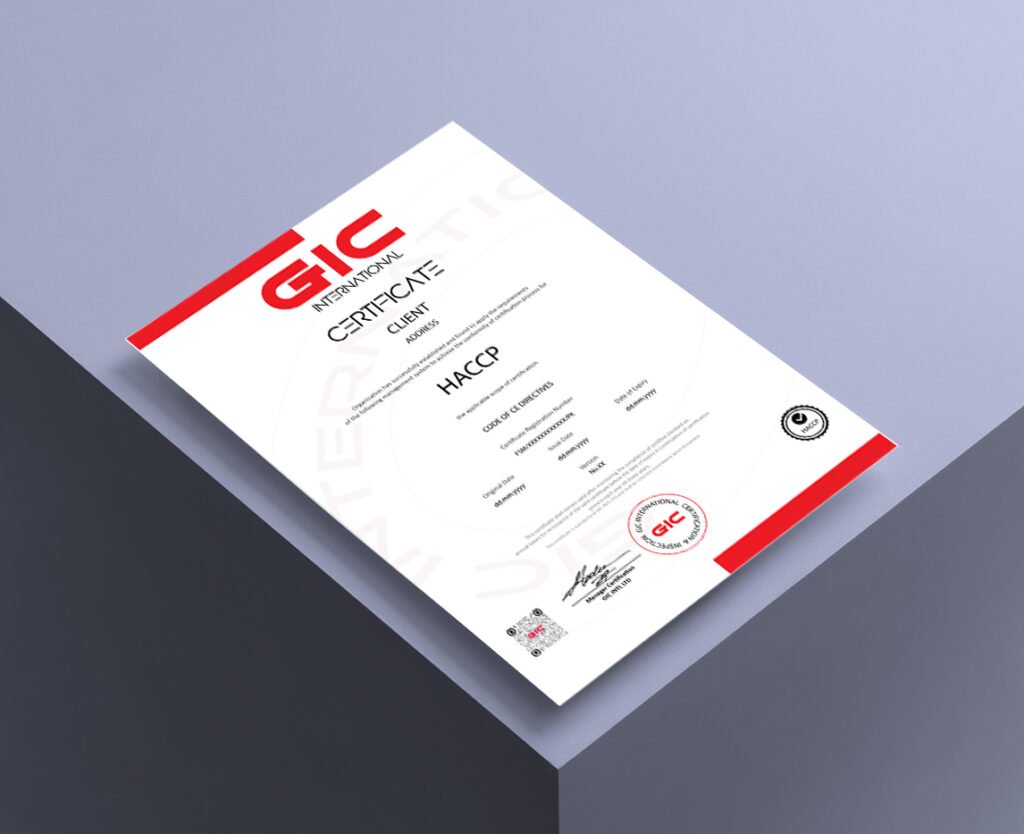
How Does GIC International Certifications Facilitate the Assessment Process?
GIC International Certifications delivers independent third-party assessment and verification services designed to evaluate organizational compliance against international food safety standards. By utilizing accredited, highly experienced lead auditors who specialize in diverse food industry sectors, GIC International Certifications provides a direct, structured pathway toward formal certification.
Rather than relying on overly complex, disruptive evaluation routines, GIC International Certifications utilizes an efficient, systematic audit methodology. The accredited lead auditors bring deep sector-specific expertise, ensuring that audits focus on practical risk mitigation, operational clarity, and objective alignment with global Codex Alimentarius standards. This high level of technical competency allows organizations across all processing sectors to navigate the audit process with clarity and achieve valid, internationally recognized certification.
What Specific Assessment Steps Are Utilized by GIC International Certifications?
To ensure total transparency and complete coverage across all operational domains, GIC International Certifications executes a streamlined, multi-phase assessment workflow. The table below details the structured methodology applied during the verification process:
| Assessment Phase | Operational Objective | Executed Audit Actions |
| Phase 1: Application Review | Scope Definition | Evaluation of organizational scope, operational scale, facility footprints, and food category profiles. |
| Phase 2: Stage 1 Desk Audit | Documentation Verification | Thorough review of written HACCP manuals, CCP determination records, process flowcharts, and prerequisite programs. |
| Phase 3: Stage 2 On-Site Audit | Operational Validation | On-site inspection of manufacturing practices, physical sanitation, live CCP monitoring, and staff interviews. |
| Phase 4: Non-Conformance Review | Deviation Resolution | Objective evaluation of corrective action evidence submitted for any identified physical or procedural gaps. |
| Phase 5: Decision & Issuance | Certification Grant | Independent technical committee review followed by formal issuance of the HACCP Certificate. |
| Phase 6: Surveillance Audits | Ongoing Compliance | Annual periodic monitoring audits to confirm continuous adherence and system maintenance. |
What Is the Tentative Timeline and Investment Structure for Assessment Services?
The operational timeline and financial investment required for securing certification depend upon facility size, workflow complexity, employee headcount, and sector-specific risk profiles. The fees outlined below represent economical regional market estimates designed to offer cost-effective validation services.
| Enterprise Category | Facility Scope & Complexity | Tentative Completion Timeline | Tentative Price Range (PKR)* |
| Micro / Small Sector | Single-line processing, low-risk handling, <20 staff | 2 to 3 Weeks | PKR 150,000 – PKR 250,000 |
| Medium Enterprise | Multi-line processing, moderate hazards, 20-100 staff | 3 to 5 Weeks | PKR 260,000 – PKR 450,000 |
| Large Industrial Facility | Complex automated lines, high risk, >100 staff | 5 to 8 Weeks | PKR 460,000 – PKR 850,000 |
| Multi-Site Operations | Distributed regional processing units & cold chains | 6 to 10 Weeks | Customized Enterprise Rate |
*Note: These are not exact prices. Final quotes are issued following a formal scope analysis by GIC International Certifications.
Why Is Professional Auditor Expertise Critical for Achieving Successful Audit Results?
The effectiveness and international validity of a certification depend heavily on the competence and rigor of the lead auditors conducting the evaluation. GIC International Certifications deploys professional, accredited lead auditors who possess deep subject-matter knowledge across various food sub-sectors, including dairy, meat processing, beverage manufacturing, fresh produce, packaging materials, and commercial distribution.
These accredited professionals bring extensive industry experience, allowing them to evaluate complex hazard maps, technical limits, and automated control procedures with precision. Their thorough understanding of global regulatory standards ensures that audits are both practical and rigorous. By maintaining an objective, expert-led evaluation environment, GIC International Certifications helps organizations build robust food safety management systems that deliver 100% compliance alignment across all sectors.
What Strategic Commercial Benefits Does Obtaining This Certification Provide?
Securing third-party verified food safety systems yields immediate operational and financial returns, protecting the enterprise while unlocking competitive market advantages.
- Expanded Market and Export Access: Major international retail chains, multinational food service brands, and foreign import agencies require suppliers to hold accredited food safety credentials prior to contract signing.
- Reduction in Product Recalls and Waste: Proactive monitoring of critical control points reduces batch failures, product spoilage, and costly commercial product recalls.
- Strengthened Legal and Regulatory Compliance: Demonstrates proactive compliance with national food safety authorities, minimizing operational disruption and regulatory penalties.
- Enhanced Brand Reputation and Consumer Trust: Displaying certified status builds consumer confidence and reinforces brand loyalty.
- Optimized Operational Efficiency: Standardizing sanitation routines, processing speeds, and monitoring checks streamlines daily facility operations.
FAQ’s
What is the primary difference between ISO 22000 and HACCP Certification?
HACCP is a specific, risk-focused system centered on hazard analysis and critical control points in processing operations. ISO 22000 is a broader management standard that incorporates HACCP principles alongside management policies, communication frameworks, and continual improvement structures.
How long remains an issued HACCP Certificate valid?
A standard certification cycle lasts for three years. During this three-year period, annual surveillance audits are conducted to ensure continuous compliance before a full recertification audit occurs at the end of the term.
Which business sectors require this food safety certification?
Any entity operating within the food chain requires certification, including primary agriculture, food processors, beverage manufacturers, packaging producers, storage providers, logistics companies, hotels, and retail caterers.
Can a facility handle the audit if non-conformances are identified?
Yes. If an auditor identifies gaps during an assessment, the business receives a defined timeframe to implement verified corrective actions. Once satisfactory evidence of resolution is submitted and approved, the certification process moves forward.
Are prerequisite programs required before undergoing a certification audit?
Yes. Facilities must establish foundational prerequisite programs (PRPs), such as Good Manufacturing Practices (GMP) and Sanitation Standard Operating Procedures (SSOP), to support an effective HACCP plan.