

Halal Certification
In today’s interconnected global economy, accessing new markets is key to growth and profitability. Halal Certification is a globally recognized assurance that your products, services, and operational processes meet the strict requirements of Islamic law. For businesses, this isn’t just a religious compliance label; it’s a powerful tool to build consumer trust, tap into a rapidly growing market, and demonstrate a commitment to quality and ethical production. GIC International helps organizations achieve this certification, enhancing their reputation and unlocking long-term commercial success.
“Explore more about Halal Certification – a vital standard for market access and consumer trust. To make your organizational ambitions a global reality, you can avail of the certification from GIC International by contacting us.”
Understanding Halal Certification
Halal Certification provides a structured framework for organizations to ensure their products are permissible for Muslim consumers. The certification, issued by accredited bodies like GIC International, outlines rigorous requirements covering sourcing, preparation, hygiene, and production. Companies using this certification can accurately identify and control all aspects of their supply chain, ensuring integrity from raw materials to the final product.
Halal is part of a broader system of ethical consumption that emphasizes cleanliness, safety, and morality. The primary objective of Halal Certification is to provide organizations with a verifiable and trusted system to meet the dietary and lifestyle needs of over 1.8 billion Muslims worldwide. By obtaining this certification, companies can achieve significant market access improvements and demonstrate their commitment to inclusivity and quality.
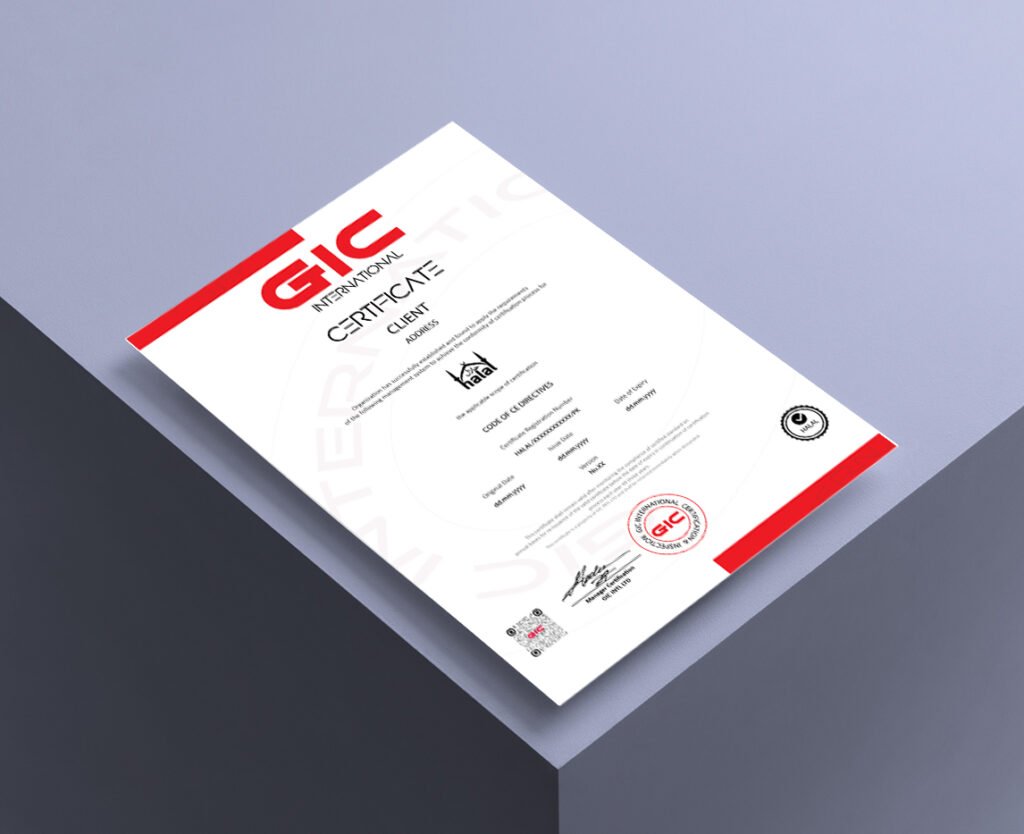
Key Elements of the Halal Certification Process
GIC International’s Halal Certification comprises several key elements that organizations must address to ensure compliance:
- Halal Policy and Management System:Organizations must establish a clear Halal policy and a management system to implement it. This system serves as the foundation for all Halal control measures and training.
- Raw Material and Ingredient Assessment:Every raw material, ingredient, and processing aid must be assessed for its Halal status. This involves thorough verification and supplier approvals to ensure no non-Halal or questionable substances are used.
- Production Process and Facility Requirements:The entire production process must be designed to prevent cross-contamination with non-Halal items. This includes dedicated equipment, stringent cleaning procedures, and facility audits to ensure compliance.
- Packaging, Labeling, and Storage:Products must be packaged and stored using Halal-compliant materials and methods, separate from non-Halal items. Accurate labeling is crucial for consumer trust.
- Internal Audits and Management Review:Organizations must conduct regular internal audits to ensure ongoing compliance. Top management must review the system periodically to ensure its effectiveness and drive continuous improvement.
Benefits of Halal Certification
- Access to a Trillion-Dollar Market
- Opens doors to the vast and growing global Muslim population.
- Provides a competitive advantage in over 57 member countries of the Organization of Islamic Cooperation (OIC).
- Enhances Brand Trust and Credibility
- Demonstrates a commitment to highest standards of quality, hygiene, and safety.
- Builds strong brand loyalty not only among Muslims but also with non-Muslims who associate Halal with ethical and pure products.
- Ensures Supply Chain Integrity and Compliance
- Provides a systematic approach to managing and verifying your supply chain.
- Mitigates risks of recalls, reputational damage, and non-compliance with international import regulations.
Challenges in Obtaining Halal Certification
Despite its benefits, obtaining Halal Certification can present challenges. A common challenge is the complexity of the modern supply chain, where ingredients can be sourced from multiple countries. To address this, GIC International provides expert guidance on supplier vetting and ingredient verification.
Another challenge is the need for initial investment in process changes and staff training. However, this investment leads to improved operational standards and opens far greater financial returns. GIC International supports organizations through this transition with clear guidelines and practical solutions.
Halal Certification and Continuous Integrity
Maintaining the integrity of the Halal status is a core principle of the certification. It is not a one-time event but a continuous commitment. This involves regular audits, ongoing staff training, and a proactive approach to any changes in ingredients or processes.
The concept of continuous improvement is embedded in the Halal management system, ensuring that organizations not only maintain their certification but also consistently enhance their operational standards, thereby strengthening consumer confidence over time.
Real-World Applications of Halal Certification
Halal Certification is applicable to a wide range of industries far beyond food and beverages.
- Food & Beverage Manufacturersuse it to ensure their products are permissible for Muslim consumers.
- Pharmaceutical and Cosmetic Companiescan certify their products to ensure all ingredients and manufacturing processes are Halal-compliant.
- Logistics and Packagingproviders can obtain certification for their services, ensuring the integrity of Halal products throughout the supply chain.
Small and medium-sized enterprises (SMEs) can significantly benefit from Halal Certification. The framework is scalable and can be tailored to the specific needs and size of the organization. By adopting it, SMEs can instantly gain a global profile, differentiate themselves, and access new export markets.
Halal Certification is a powerful strategic tool for any organization aiming to thrive in the global marketplace. By partnering with GIC International, companies can seamlessly navigate the certification process, ensure the integrity of their products, and build unwavering trust with a vast consumer base. Despite the initial steps required for implementation, the commercial and reputational benefits are substantial. With a strong commitment to quality and ethical practices, organizations can achieve long-term success and sustainability. Whether you are a large corporation or an ambitious small business, embracing Halal Certification with GIC International can transform your market reach and drive your organization toward global excellence.