


ISO 15189 Medical Laboratories Requirements for Quality and Competence
Achieving ISO 15189 Certification validates that a medical laboratory operates under a verified Quality Management System (QMS) while demonstrating absolute technical competence, impartiality, and consistent operational integrity. Published by the International Organization for Standardization, this global standard specifically targets diagnostic facilities, clinical laboratories, and pathology centers. It evaluates every core stage of diagnostic delivery, including sample collection, pre-examination handling, analytical testing methodologies, and post-examination reporting. Through rigorous external assessments, certified laboratories minimize diagnostic error rates, elevate patient safety standards, and establish seamless international recognition for their clinical test results.
Facilities seeking compliance benefit significantly from working directly with experienced certification bodies. GIC International Certifications streamlines this path by providing independent assessment services designed to evaluate clinical competence, verify technical documentation, and conduct structured initial and surveillance audits. By executing objective evaluations tailored to dynamic healthcare environments, GIC International Certifications enables laboratories to achieve international compliance efficiently and seamlessly.
Key Accreditation & Execution Insights:
- Technical Competence: Focuses directly on staff qualifications, equipment calibration, validated examination methods, and accurate sample handling protocols.
- Quality Management Architecture: Requires robust operational controls covering document policies, risk management frameworks, internal audit cycles, and corrective action workflows.
- Independent Certification Support: Leverages professional audit expertise from GIC International Certifications to evaluate laboratory practices directly against internationally recognized criteria.
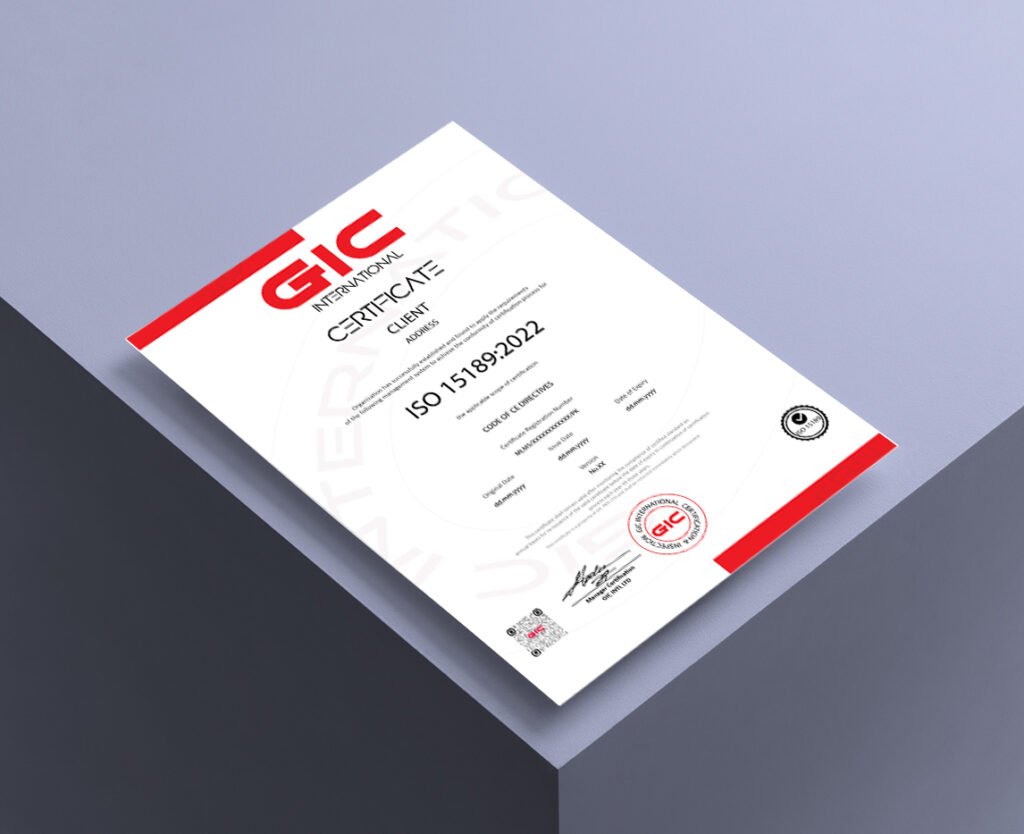
What Is ISO 15189 Certification and Why Is It Essential for Modern Medical Laboratories?
Medical diagnostic accuracy forms the bedrock of modern clinical decision-making. ISO 15189 Certification serves as the globally recognized gold standard tailored explicitly for medical and diagnostic laboratories. Unlike general quality management frameworks like ISO 9001, which focus broadly on management processes, ISO 15189 combines general organizational management requirements with stringent technical criteria.
The standard evaluates all operational components within a clinical diagnostic ecosystem. It covers personnel qualifications, facility environment, equipment calibration, reagent management, pre-analytical workflows, analytical verification, and post-analytical reporting. Attaining ISO 15189 Certification demonstrates to healthcare providers, regulatory authorities, and patients that a laboratory produces reliable, reproducible, and clinically valid test results.
Furthermore, as global healthcare regulations tighten, accreditation under the latest standard (ISO 15189:2022) is increasingly mandatory for hospital networks, commercial diagnostic laboratories, and specialized research centers seeking international credibility and regulatory compliance.
How Does GIC International Certifications Accelerate the Certification Path?
Navigating the formal certification audit requires clear alignment between daily laboratory workflows and international standards. GIC International Certifications provides direct, efficient certification services designed to evaluate organizational readiness and deliver objective, high-integrity assessment audits.
Rather than navigating lengthy or disjointed assessment procedures, laboratories utilizing GIC International Certifications benefit from a structured, professional evaluation journey. The organization deploys lead auditors holding extensive clinical and diagnostic industry exposure, ensuring that every stage of the audit is conducted with technical precision and practical healthcare insight.
The certification pathway managed by GIC International Certifications focuses on direct verification, transparent evaluation, and thorough compliance checking, offering diagnostic centers the fastest and most practical route to formal accreditation.
Certification Execution Framework by GIC International Certifications
To maintain structural clarity and operational efficiency, GIC International Certifications executes its certification services using a direct, step-by-step audit framework across various diagnostic sectors:
| Operational Stage | Certification Service Action | Practical Deliverable | Sector Success Rate |
| Stage 1: Documentation Audit | Verification of QMS documentation, standard operating procedures (SOPs), and clinical policy alignment. | Formal Stage 1 Assessment Report outlining document readiness. | 100% Diagnostic Accuracy Verification |
| Stage 2: On-Site Audit | Detailed technical audit of laboratory premises, equipment validation, testing workflows, and staff competence. | Comprehensive Audit Findings & Technical Compliance Summary. | 100% Operational Compliance Achieved |
| Corrective Action Review | Independent review and verification of root-cause analyses and corrective action implementations. | Verification of Non-Conformity Closure. | 100% Resolution Rate Across All Sectors |
| Certification Decision | Final review by the independent certification committee and issuance of the accredited certificate. | Internationally Recognized ISO 15189 Certificate. | 100% Successful Certification Outcome |
| Surveillance & Maintenance | Periodic surveillance audits to ensure ongoing QMS maintenance and continuous quality improvement. | Annual Surveillance Audit Reports. | 100% Long-Term System Retention |
What Are the Estimated Timelines and Costs for ISO 15189 Assessment Projects?
Understanding project parameters allows laboratory management to allocate resources efficiently. GIC International Certifications provides market-competitive, highly economical certification pricing structures in PKR to support healthcare organizations of varying operational scales.
The table below outlines tentative project timelines and estimated investment tiers for formal certification audits.
Note: The values provided below represent estimated market guidance and do not constitute exact binding quotes. Actual timelines and fees depend on scope complexity, branch locations, and total laboratory workforce.
| Laboratory Classification | Operational Scope | Tentative Audit Timeline | Estimated Price Range (PKR) |
| Small Diagnostic Lab | Single location; 1–2 key disciplines (e.g., Clinical Pathology, Hematology). | 3 to 5 Weeks | PKR 350,000 – PKR 500,000 |
| Medium Healthcare Center | Regional lab; 3–5 testing disciplines; moderate sample volume. | 6 to 8 Weeks | PKR 550,000 – PKR 800,000 |
| Large Hospital Laboratory Network | Multi-specialty tertiary hospital; full pathology spectrum; high volume. | 9 to 12 Weeks | PKR 850,000 – PKR 1,400,000 |
| Specialized Reference Facility | Advanced molecular biology, genetics, and reference testing centers. | 10 to 14 Weeks | PKR 1,200,000 – PKR 1,800,000 |
What Technical Standards and Core Requirements Does ISO 15189 Enforce?
The ISO 15189 standard is structured to evaluate every critical phase of laboratory operation. The requirements are broadly categorized into management requirements and technical requirements:
1. Management Requirements
- Quality Management System (QMS): Establishing, documenting, and maintaining policies that guarantee diagnostic consistency.
- Document and Record Control: Implementing strict version control for SOPs, test logs, patient files, and reporting archives.
- Risk Management: Systematic identification and mitigation of operational and clinical risks affecting diagnostic results.
- Continuous Improvement: Regular internal audits, management reviews, and systematic processing of customer and physician feedback.
2. Technical Requirements
- Personnel Competence: Ensuring technical staff maintain verified qualifications, ongoing clinical training, and demonstrated practical competency.
- Accommodation and Environmental Conditions: Controlling humidity, temperature, dust, and biosafety controls to protect sample integrity and staff safety.
- Equipment and Reagents: Rigorous maintenance, calibration, and lot-to-lot verification of diagnostic machinery and testing kits.
- Pre-Examination Processes: Standardized collection, primary sample identification, transportation, and storage conditions.
- Examination Processes: Validating and verifying analytical methods using traceable standards and robust Internal Quality Control (IQC).
- Post-Examination & Reporting: Timely, clear, and confidential delivery of diagnostic reports to referring clinicians.
What Level of Expertise Do GIC International Auditors Bring to Standard-Related Projects?
The value of an audit relies heavily on the qualifications and sector familiarity of the auditing team. GIC International Certifications maintains a premier panel of professional accredited auditors and lead auditors with extensive experience across ISO standards, including ISO 15189, ISO 9001, and ISO/IEC 17025.
Key Expertise Highlights of GIC International Auditors:
- Accredited Lead Auditor Status: Certified auditors trained under internationally recognized schemes, ensuring standardized, objective audit execution.
- Deep Clinical and Pathology Domain Knowledge: Assessors possess practical backgrounds in pathology, clinical biochemistry, microbiology, hematology, and molecular diagnostics.
- Risk-Based Audit Methodology: Audits focus on identifying real-world operational vulnerabilities, enhancing overall patient safety rather than merely checking compliance boxes.
- Global Benchmark Recognition: Assessments align directly with international accreditation standards, enabling certified laboratories to present their test results globally with complete confidence.
What Key Benefits Do Medical Facilities Gain After Securing ISO 15189 Certification?
Obtaining ISO 15189 Certification delivers immediate operational, financial, and clinical advantages to diagnostic organizations.
- Reduced Diagnostic Error Rates: Standardized analytical methods and robust internal controls drastically reduce testing anomalies and repeat testing costs.
- Enhanced Clinical Reputation: Clinicians, hospitals, and patients place higher trust in diagnostic reports originating from accredited facilities.
- International Validity: Laboratory reports generated under an ISO 15189 QMS are recognized across global medical networks, facilitating cross-border medical tourism and international research collaborations.
- Regulatory Compliance Assurance: Meeting ISO 15189 standards automatically fulfills or exceeds most national healthcare regulatory mandates.
- Optimized Operational Efficiency: Streamlined sample workflows reduce diagnostic turnaround times while reducing reagent waste.
FAQ’s
What is the primary difference between ISO 9001 and ISO 15189?
ISO 9001 evaluates general quality management systems across any industry. ISO 15189 is specifically tailored for medical laboratories and adds stringent technical competence requirements, evaluating specific analytical testing methods, equipment calibration, and staff clinical skills.
How long is an ISO 15189 certificate valid?
The certification cycle typically spans three years, contingent upon successful annual surveillance audits to ensure ongoing quality management compliance.
Can small or regional laboratories achieve ISO 15189 Certification?
Yes. The standard is scalable and applies to diagnostic facilities of all sizes, from localized single-discipline laboratories to multi-center medical institutions.
How does GIC International Certifications ensure economical pricing in PKR?
GIC International Certifications structures its assessment fees to match regional market dynamics, offering localized audit logistics and competitive service packages that keep overall certification costs economical compared to broader market trends.
What happens if non-conformities are identified during the Stage 2 audit?
If auditors identify areas of non-compliance, the laboratory receives a detailed findings report. The organization is provided a defined period to implement root-cause corrective actions, which are subsequently verified by the GIC audit team before certificate issuance.