

GMP – Good Manufacturing Practice
In the competitive global marketplace, particularly in industries like pharmaceuticals, food, and medical devices, product quality and safety are non-negotiable. GMP (Good Manufacturing Practice) is a globally recognized system that ensures products are consistently produced and controlled according to rigorous quality standards. For a company like GIC International, operating in international trade and certification, GMP Certification is the cornerstone of guaranteeing that the products you source, distribute, or certify are safe, effective, and of high quality. Adhering to GMP not only mitigates risks but also builds unparalleled trust with clients and regulatory bodies worldwide.
“Given below is more detail about GMP – a foundational quality system, and you might be interested in learning more about it. For the rest, you can avail the certification and advisory services from GIC International to make your organizational dream come true by contacting us.”
Understanding GMP
GMP provides a framework for manufacturers to ensure their products are consistently produced and controlled to the quality standards appropriate for their intended use. Unlike testing a finished product to find defects, GMP is a proactive, risk-management based system that emphasizes quality built into every step of the manufacturing process—from the raw materials, premises, and equipment to the training and hygiene of staff. GIC International recognizes that GMP Certification covers all aspects of production to minimize risks that cannot be eliminated through testing the final product alone.
GMP is not a single standard but a set of general principles enshrined in regulations by bodies like the US FDA and the European Medicines Agency, and detailed in guidelines like the WHO GMP and ICH Q7. The primary objective is to prevent contamination, mix-ups, deviations, and errors, thereby ensuring that consumers receive a product that is safe and has the quality and purity characteristics it is supposed to have.
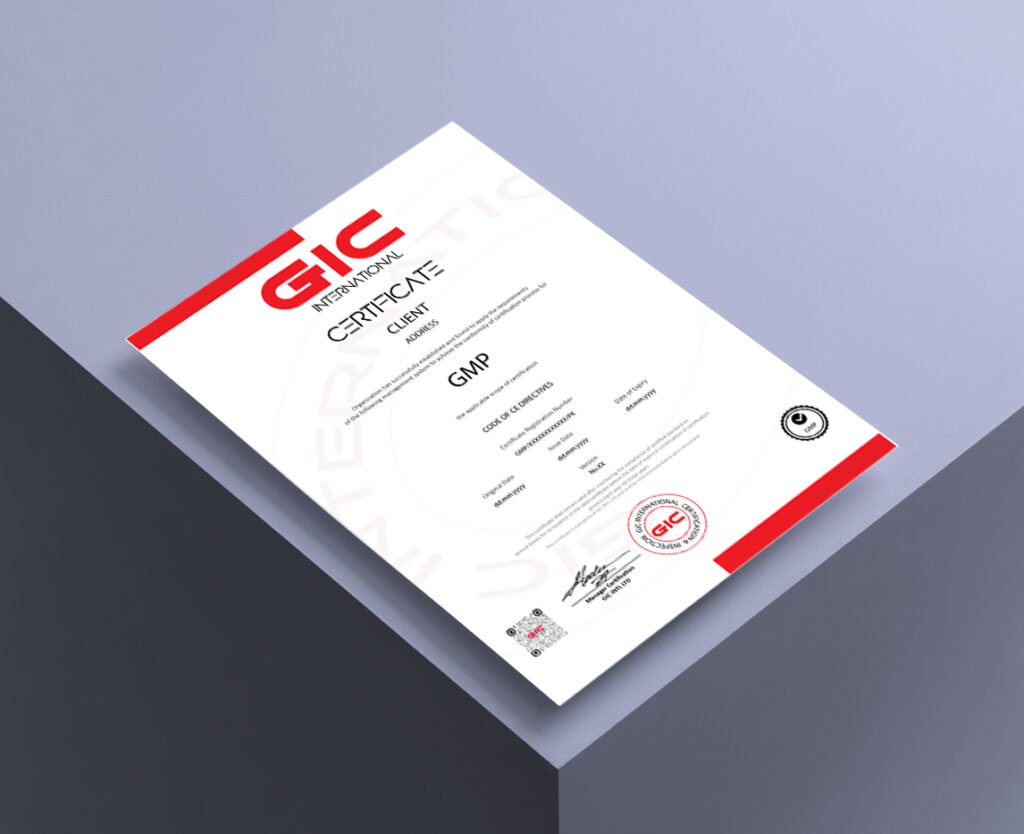
Key Elements of GMP
GMP comprises several key elements, often referred to as the “Five P’s,” that organizations must rigorously address:
- People (Personnel):All personnel must have the qualifications, training, and clear responsibilities to perform their duties. This includes maintaining high levels of personal hygiene and understanding the critical importance of GMP Certification procedures.
- Premises and Equipment:Manufacturing facilities must be designed, constructed, and maintained to facilitate proper cleaning, prevent contamination, and allow logical workflow. Equipment must be calibrated, cleaned, and maintained to function as intended.
- Processes (Procedures):All manufacturing processes must be clearly defined, systematically reviewed, and proven to be capable of consistently manufacturing products of the required quality. Processes must be documented in Standard Operating Procedures (SOPs) and followed without exception.
- Products (Materials):Control must be exercised over all starting materials, intermediates, and finished products. This includes establishing robust specifications, conducting identity and quality testing, and ensuring proper storage and handling.
- Procedures (Documentation & Records):Comprehensive documentation is essential. This provides a complete history of each batch, from raw material receipt to final distribution. Accurate records enable traceability and are critical for investigating and correcting any deviations.
Benefits of GMP
- Ensures Product Quality and Safety
- Systematically prevents errors and contamination.
- Guarantees that every batch of product meets its predefined specifications, protecting end-user health.
- Facilitates International Market Access
- GMP compliance is a fundamental requirement for entering regulated markets like the US, EU, and many others.
- A GMP certificate from a recognized body like GIC International serves as a passport to global trade.
- Reduces Risks and Costs
- Minimizes the risk of product recalls, rejections, and regulatory sanctions, which are costly and damage reputation.
- Builds a culture of quality that leads to greater operational efficiency and less waste.
Challenges in Implementing GMP
Despite its clear benefits, implementing a robust GMP Certification system can present challenges. A significant hurdle is the initial investment in facility upgrades, equipment, and training. GIC International can help organizations develop a phased approach to make this manageable.
Another common challenge is cultural resistance and the rigorous discipline required for consistent documentation and procedure-following. Overcoming this requires strong leadership commitment, continuous training, and a transparent quality culture where every employee feels responsible for quality.
GMP and Continuous Improvement
GMP is not a one-time achievement but a system of continuous improvement. Regulations themselves evolve, and manufacturers must continually assess and enhance their quality systems. The concept of Quality Risk Management (QRM) is integral to modern GMP, allowing companies to proactively identify and control potential quality issues.
The Plan-Do-Check-Act (PDCA) cycle is a fundamental tool for driving this continuous improvement, ensuring that processes are regularly reviewed, audited, and optimized for better performance and compliance.
Real-World Applications of GMP
GMP is critical across multiple sectors:
- Pharmaceuticals:Ensures that every tablet, vial, or capsule has the correct identity, strength, and purity, and is free from contamination.
- Medical Devices:Guarantees that devices, from simple syringes to complex implants, are safe, reliable, and perform as intended.
- Food and Beverages:Applied as Good Hygiene Practices (GHP) and HACCP, it prevents foodborne illnesses and ensures food safety.
- Cosmetics:Ensures products are safe for consumer use and are produced under hygienic conditions.
GMP Certification is the undisputed foundation for manufacturing excellence in quality-critical industries. By implementing and certifying against GMP standards, companies can ensure unparalleled product quality, comply with international regulations, and secure a powerful competitive advantage. While the path to full compliance requires dedication and resources, the long-term benefits of market trust, risk reduction, and operational excellence are immense. GIC International is your partner in this journey, providing the expertise and certification services to help your organization achieve and maintain GMP compliance, driving you toward a future of sustainable quality and global success.