

ISO 20000-1 IT Service Management System
ISO 20000-1 Certification represents the globally recognized benchmark for an Information Technology Service Management System (ITSMS). Achieving ISO 20000-1 Certification enables technology organizations, managed service providers (MSPs), cloud operators, and internal enterprise IT divisions to structure, manage, and continuously improve their service delivery processes. By aligning with this international framework, businesses establish robust Service Level Agreements (SLAs), optimize incident and change management workflows, mitigate operational risks, and maintain regulatory compliance. Organizations verified against this standard demonstrate uncompromising commitment to quality, positioning themselves for sustainable competitive growth and seamless client trust.
The path to ISO 20000-1 Certification requires structured alignment with international operational guidelines, ensuring that IT operations meet precise quality criteria. Organizations must establish systematic procedures covering service design, transition, delivery, and ongoing performance evaluation. Partnering with a globally recognized certification body ensures that the assessment process is conducted with high accuracy, validity, and efficiency, providing an objective credential that unlocks access to global commercial opportunities.
- Primary Objective: Deliver a formal, third-party audit and verification of an IT organization’s Service Management System against ISO/IEC 20000-1 criteria.
- Key Execution Pillars: Independent Stage 1 readiness assessment, Stage 2 implementation audit, official certification issuance, and annual surveillance assessments.
- Strategic Outcome: Optimized IT operational efficiency, reduced service downtime, seamless incident handling, and global market recognition.
- Target Enterprise Profile: Managed Service Providers (MSPs), cloud platforms, IT outsourcing vendors, financial technology providers, and enterprise IT departments.
What Is ISO 20000-1 Certification and Why Is It Critical for IT Operations?
ISO 20000-1 Certification is the international standard dedicated exclusively to IT service delivery. Unlike informal best-practice frameworks like ITIL, ISO 20000-1 serves as a certifiable management system. It provides a comprehensive framework that mandates how organizations plan, design, transition, deliver, and improve services to satisfy customer and business demands.
In a marketplace driven by rapid digital transformation, downtime, service interruptions, or poorly executed changes can disrupt business operations. ISO 20000-1 Certification ensures that an organization’s IT service management relies on structured, repeatable, and audited processes rather than individual, ad-hoc efforts. This discipline allows IT teams to manage capacity, handle incidents rapidly, protect data integrity, and enforce robust change controls across all service touchpoints.
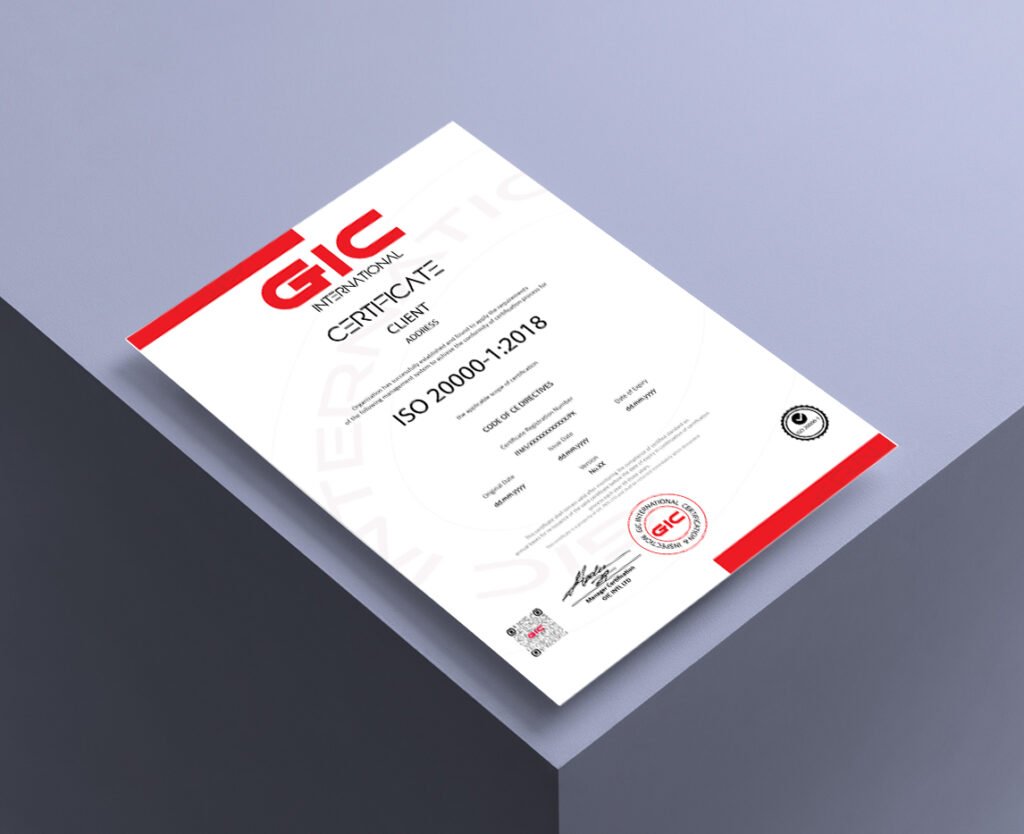
How Does ISO 20000-1 Certification Standardize Service Delivery and SLAs?
Achieving ISO 20000-1 Certification forces organizations to rigorously define their service offerings and formalize customer commitments. The framework mandates the creation of a clear Service Catalogue alongside formal Service Level Agreements (SLAs). This structural clarity guarantees that service expectations are aligned between providers and clients prior to service deployment.
By establishing standard operational workflows for problem management, configuration management, and service continuity, organizations minimize unexpected service outages. The standard embeds the Plan-Do-Check-Act (PDCA) cycle, ensuring that service metrics are routinely monitored, reviewed, and refined. This proactive approach reduces operational reactive firefighting, improves system availability, and secures consistent compliance with customer contracts.
How Can GIC International Assist Organizations in Achieving ISO 20000-1 Certification Fast and Efficiently?
GIC International facilitates the certification process by providing accredited third-party auditing and evaluation services designed to be thorough, fast, and transparent. Operating as an internationally recognized certification body, GIC International streamlines the formal audit roadmap to eliminate bureaucratic friction and unnecessary delays.
Through a structured evaluation framework, GIC International delivers independent assessment services, helping organizations validate their compliance against international standards with minimal operational friction. The certification path is designed to be accessible and efficient, enabling technology providers to achieve internationally valid accreditation within optimized timeframes.
| GIC International Certification Effort | Operational Scope & Execution | Value Delivered |
| Stage 1 Document & Readiness Audit | Complete evaluation of ITSM policies, scope definitions, SLA documentation, and system readiness. | Identifies operational gaps early to prevent delays during final certification. |
| Stage 2 On-Site & Digital Audit | Rigorous verification of operational workflows, incident handling, and change management execution. | Validates standard compliance across active IT operations and infrastructure. |
| Independent Certification Issuance | Formal review by certification board followed by the grant of accredited certification. | Delivers global trust, market differentiation, and formal tender eligibility. |
| Surveillance & Continual Audit | Scheduled annual surveillance evaluations to preserve audit readiness and standard compliance. | Ensures continuous operational alignment and long-term standard adherence. |
What Is the Expected Timeline and Economical Investment for ISO 20000-1 Certification?
The duration and cost of obtaining ISO 20000-1 Certification depend on factors such as organization size, scope complexity, infrastructure scale, and team readiness. GIC International maintains a customer-focused pricing model, providing cost-effective certification solutions compared to market trends without compromising auditing standards.
The table below outlines the tentative timeline phases and economical project pricing in PKR for varying organizational sizes.
| Organization Size & Scope | Assessment Phase & Activities | Tentative Timeline | Tentative Price Range (PKR)* |
| Small IT Enterprise / Startup (1 – 25 Employees) | Initial Application, Stage 1 Readiness Audit, Stage 2 Certification Audit | 3 to 4 Weeks | PKR 250,000 – PKR 380,000 |
| Medium Enterprise / MSP (26 – 100 Employees) | Comprehensive Scope Audit, Multi-department Evaluation, Stage 1 & 2 Audits | 4 to 6 Weeks | PKR 400,000 – PKR 600,000 |
| Large Corporate / Cloud Center (100+ Employees) | Multi-site Evaluation, Infrastructure & Security Verification, Stage 1 & 2 Audits | 6 to 8 Weeks | PKR 650,000 – PKR 950,000 |
*Note: These are not exact prices. Final fees are customized based on specific operational scope, physical/digital locations, and employee counts upon project application review.
Why Is GIC International’s Auditor Expertise Unmatched for IT and Cyber Security Projects?
GIC International maintains a team of qualified, professional lead auditors with deep domain expertise across IT service management, information security, and cyber security domains. Selecting auditors who understand technical architecture, cloud ecosystems, network infrastructure, and modern data security frameworks is essential for a meaningful evaluation.
The accredited lead auditors at GIC International bring technical insight to every audit project. Their expertise spans multi-standard ecosystems, allowing seamless certification alignment across ISO 20000-1 (ITSM), ISO 27001 (Information Security Management), and complementary cyber security frameworks. This expert audit execution ensures that the scope of the project is thoroughly verified, resulting in 100% successful and credible certification outcomes for client organizations across all sectors.
What Key Business Benefits Does ISO 20000-1 Certification Deliver to Tech Companies?
ISO 20000-1 Certification provides tangible commercial and operational advantages for technology organizations aiming to expand their client portfolio.
- Global Competitive Advantage: ISO 20000-1 Certification serves as a key prerequisite in international procurement tenders, RFP processes, and vendor qualification benchmarks.
- Enhanced Customer Confidence: Third-party certification provides objective proof to enterprise clients that service delivery relies on structured, reliable, and audited controls.
- Reduced Operational Friction: Standardized incident and problem management procedures reduce mean time to resolution (MTTR) during unexpected outages.
- Stronger Alignment with Information Security: Seamlessly integrates with information security standards (such as ISO 27001), protecting sensitive client data across all managed environments.
- Optimized Resource Allocation: Clear role definitions and configuration management prevent duplication of effort and optimize resource utilization across IT operations.
FAQ’s
What is the difference between ISO 20000-1 and ITIL?
An accredited certification body formally audits and certifies an organization against ISO 20000-1, an international standard for IT service management. In contrast, ITIL offers best-practice guidance and recommendations.
How long is the ISO 20000-1 Certification valid after issuance?
The ISO 20000-1 Certificate is valid for three years. Maintaining certification requires annual surveillance audits to ensure ongoing compliance, followed by a recertification audit at the end of the three-year cycle.
Can small and medium-sized IT businesses achieve ISO 20000-1 Certification?
Yes. The ISO 20000-1 standard is scalable and applies to organizations of any size, from small tech startups and local MSPs to multinational corporations.
Can ISO 20000-1 be audited alongside ISO 27001 for Information Security?
Yes. Many technology organizations conduct integrated audits for ISO 20000-1 and ISO 27001 simultaneously, reducing overall audit duration and optimizing administrative efficiency.
How does GIC International guarantee a fast certification process?
GIC International leverages experienced lead auditors, responsive project handling, and optimized audit scheduling to conduct Stage 1 and Stage 2 evaluations without unnecessary delays.