
ISO 27001 Information Security Management System (ISMS)
ISO 27001 Certification represents the international standard for establishing, implementing, maintaining, and continually improving an Information Security Management System (ISMS). It provides a structured, risk-based framework designed to safeguard confidential data assets, secure digital infrastructure, and guarantee business continuity across modern enterprise environments.
For organizations aiming to demonstrate proof of data protection, compliance, and cyber resilience, attaining certification verifies that information security controls meet strict international criteria set by the International Organization for Standardization (ISO) and the International Electrotechnical Commission (IEC).
Key Information Security Management Metrics
- Core Objective: Preservation of Confidentiality, Integrity, and Availability (CIA triad) of information assets.
- Governing Standard: ISO/IEC 27001:2022.
- Framework Application: Risk assessment, vulnerability mitigation, physical security, access control, and IT governance.
- Target Sectors: Information Technology, Financial Services, Cloud Computing, Healthcare, Telecommunications, and Government Contracting.
- Certification Validity: 3 years (subject to annual surveillance audits).
What Is ISO 27001 Certification And Why Is It Critical For Modern Enterprises?
ISO 27001 Certification serves as global proof that an organization manages its data security risks through an audited management system. Beyond simple compliance, it reassures partners, regulators, and customers that sensitive records—ranging from employee records and financial data to proprietary code—are fully protected against unauthorized exposure, cyber theft, and system breaches.
In an era dominated by rapid digital transformation and severe cyber threats, standard IT measures are no longer sufficient. Achieving certified status demonstrates that leadership takes proactive risk management seriously, satisfying regulatory demands such as local data privacy rules and global standards like GDPR.
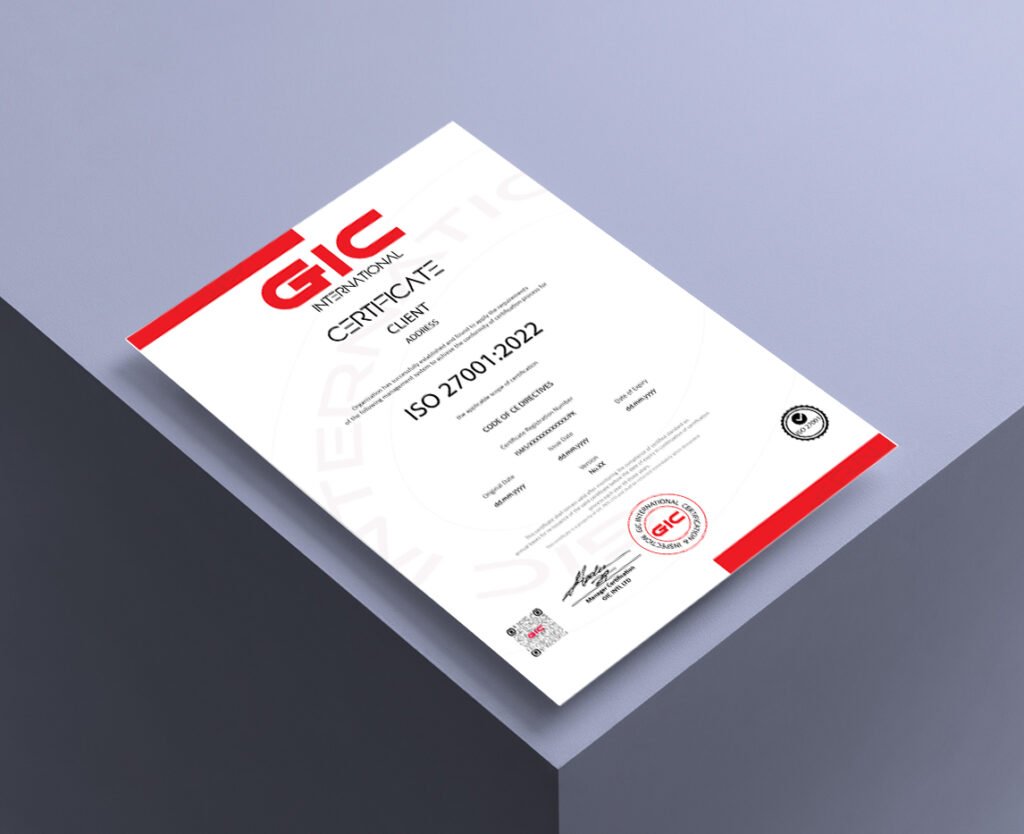
What Are The Primary Business Benefits Of Obtaining ISO 27001 Certification?
The commercial and operational impacts of achieving ISO 27001 Certification stretch across every layer of an enterprise. Businesses that achieve this accredited standard unlock distinct operational advantages:
- Risk Reduction and Incident Prevention: Systematically identifies vulnerabilities, reducing the likelihood and financial impact of security incidents.
- Enhanced Client Trust: Signals to enterprise clients that your security practices have been independently audited.
- Regulatory Compliance: Aligns operations with data privacy laws and contractual duties, preventing legal penalties.
- Competitive Differentiation: Helps secure commercial contracts where certified compliance is a prerequisite.
How Does GIC International Certifications Facilitate Fast And Efficient Certification?
GIC International Certifications provides independent assessment and verification services to help your organization achieve compliance without friction. Operating with a streamlined assessment approach, GIC International Certifications enables businesses to move efficiently from initial audit planning to final accreditation.
By evaluating existing frameworks against ISO standards, accredited auditors help simplify complex assessments, cut through audit friction, and provide clear paths to certification.
What Specific Services Are Executed By GIC International Certifications During Assessment?
GIC International Certifications provides systematic, highly structured assessment activities designed for high efficiency and total compliance accuracy.
| Audit Phase | Assessment Action | Enterprise Outcome |
| Initial Assessment | Thorough document review of the scope statement, policies, and Annex A controls. | Identifies system readiness before onsite verification begins. |
| Stage 1 Compliance Audit | Detailed examination of governance documentation, ISMS scope, and operational records. | Verifies operational readiness for full verification. |
| Stage 2 Verification Audit | Comprehensive testing of security controls, technical infrastructure, and employee practices. | Confirms effective operational controls and standard compliance. |
| Independent Review | Technical review by senior accreditation committees. | Validates complete objectivity and global audit validity. |
| Surveillance Maintenance | Scheduled yearly checks over the 3 year cycle. | Ensures lasting cybersecurity standards and continuous resilience. |
What Is The Tentative Timeline And Estimated Cost Structure For Certification Projects?
The total time and investment required depend on company size, scope complexity, and organizational readiness. Below is a tentative framework offering an economical pricing model designed to beat average market rates.
(Note: The timelines and prices listed below are estimated projections, not exact prices.)
| Company Category | Scope & Employee Count | Tentative Timeline | Estimated Certification Fee (PKR) |
| Small Enterprise | 1 to 25 Employees | 3 to 4 Weeks | PKR 250,000 |
| Medium Enterprise | 26 to 100 Employees | 5 to 7 Weeks | PKR 420,000 |
| Large Enterprise | 101 to 500 Employees | 8 to 12 Weeks | PKR 650,000 |
| Corporate/Multinational | 500+ Employees / Multi-Site | 12+ Weeks | PKR 950,000+ |
What Professional Expertise Does GIC International Certifications Bring To Cyber and Information Security Projects?
Navigating complex digital environments requires certified, field-tested expertise. GIC International Certifications fields teams of professionally accredited Lead Auditors with deep sector knowledge across IT, cloud infrastructure, network security, and risk mitigation.
Auditor Qualifications & Domain Expertise
- Certified ISO 27001 Lead Auditors: Globally qualified experts trained under strict IRCA standards.
- Cybersecurity Domain Mastery: Direct experience auditing cloud platforms (AWS, Azure, GCP), data centers, fintech APIs, and enterprise networks.
- Sector Versatility: Proven 100% audit execution track record across software houses, financial firms, healthcare networks, and telecom providers.
- Objective Technical Verification: Precise assessment techniques that evaluate technical security controls without disrupting daily operations.
FAQ’s
How long is the certificate valid once granted?
The certificate is valid for three years. Maintaining certification requires passing annual surveillance audits to ensure standard compliance over time.
Can small businesses and startups achieve certified status economically?
Yes. The standard is scalable. Assessment processes adapt to fit the scope, size, and operational complexity of small businesses, keeping costs accessible.
What is the main difference between Stage 1 and Stage 2 audits?
Stage 1 reviews your documentation, policies, and readiness. Stage 2 tests the real-world operational effectiveness of your security controls and processes.
How does the 2022 update impact standard requirements?
The ISO 27001:2022 update streamlined Annex A controls into 4 main themes (Organizational, People, Physical, and Technological), making it easier to integrate with modern cloud ecosystems and cyber defense tools.